
Why might someone living with a Dementia lose their ability to stop and think before they react?
This is something we explored recently during our Identity training, held at the Evolve Care Academy.
Think about something simple; maybe someone says something that annoys you.
Your immediate feeling might be anger or frustration. But most of us don’t act on that feeling straight away. Our brain gives us an opportunity to process what has happened, think about the situation, and decide how we want to respond.
The Traffic Light System breaks that process down into three stages:
🔴 Red – Feeling
Something happens and creates a feeling. We don’t necessarily choose that initial emotional response; it just happens.
🟠 Amber – Thinking
Before we act, our brain can process that feeling. We can use logic and reasoning to understand what has happened and consider what we do next.
🟢 Green – Action
Once we have processed the feeling, we respond with action.
For most of us, that amber stage happens countless times a day without us consciously thinking about it.
But Dementia can affect the parts of the brain involved in processing information, problem-solving, regulating emotions and making decisions. As someone’s Dementia journey progresses, their ability to access that ‘amber light’ can become increasingly affected, until sadly it goes out permanently. When this happens, it’s not possible to turn it back on.
So imagine experiencing fear, frustration or confusion, but finding it increasingly difficult to pause, process why you feel that way and reason through what should happen next, until eventually, that ability is lost altogether.
There is no longer any space between feeling and action.
🔴 Feeling → 🟢 Action
Understanding the impact of a missing amber light is so important in Dementia care.
A response may seem sudden to us. Someone might shout, push something away, or react in a way we would not expect.
But the Traffic Light System helps explain that this is not necessarily a conscious decision, nor does it mean the person is intentionally trying to hurt someone or lash out.
Before their action, there was a feeling.
So rather than trying to correct the behaviour or reason with the person, our job is to look back towards the red light.
What happened just before? Were they frightened? Did something confuse them? Did they feel rushed, uncomfortable or as though they had lost control? What might they be trying to communicate through their response?
We may not be able to switch the amber light back on, but we can change what happens around the person. We can reassure rather than reason, reduce what is causing distress and do our best to understand and meet the need they are communicating.
Because when someone can no longer stop and explain what is wrong, their behaviour may be the way they are telling us. Our job is to make sure we are listening.
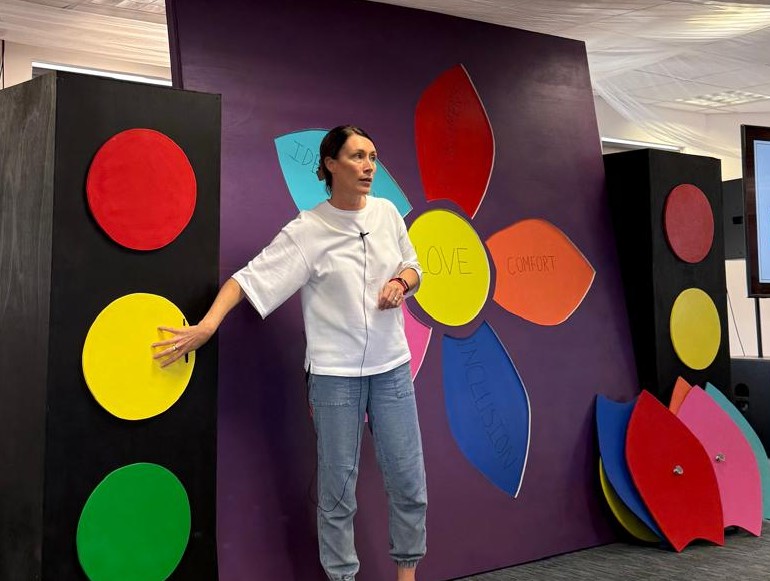
Clinical Director, Eve Carder, explains the Traffic Light System in Dementia.
To read more about the training, learning and development provided by Evolve Care Academy, visit Evolve Care Academy.